
Hear about it while it's still small
Monitoring only matters if someone acts on it. DMARCER turns a slipping security posture into a clear, specific alert (in the app, by email, or as a ticket in the system your team already works in) and closes it again automatically once the problem is fixed.
Checks per domain, each one alertable
Ways to be told: in-app, email, ticket
Resolved when the problem clears
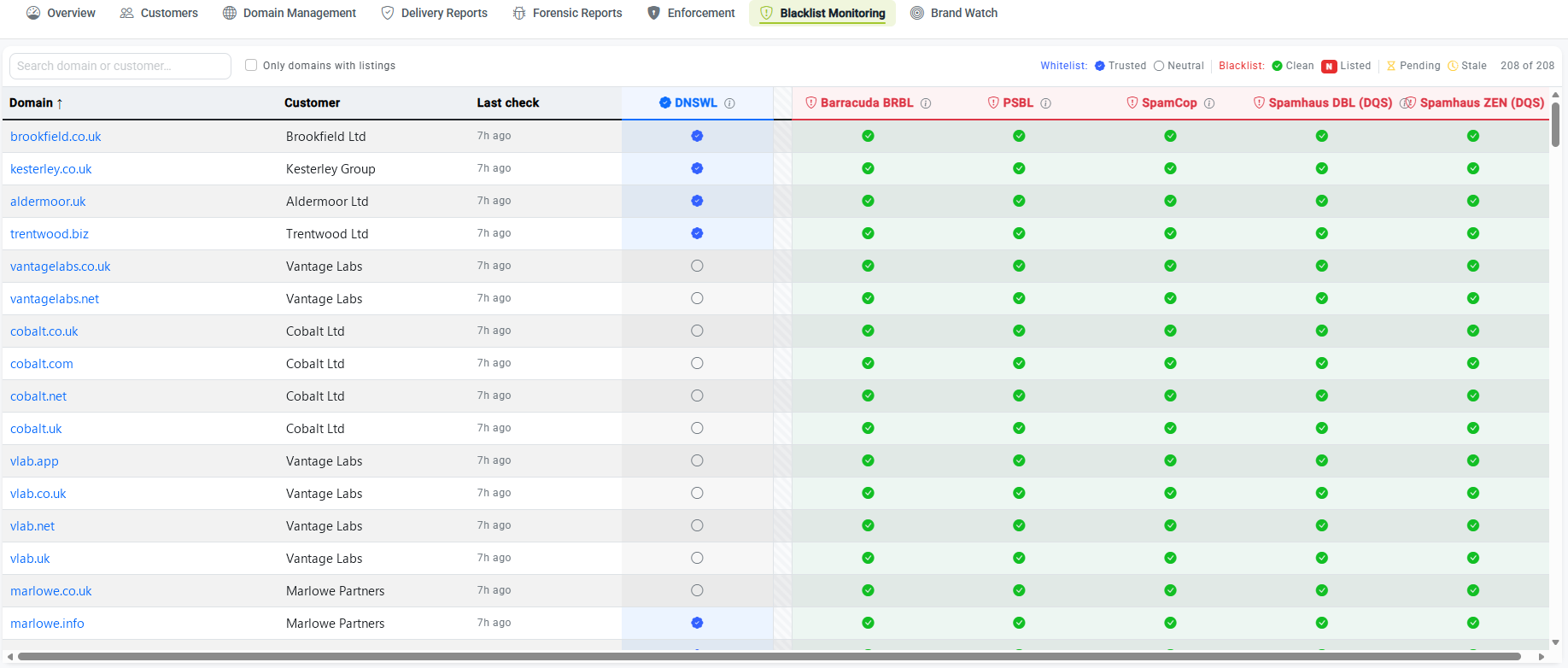
Every domain, every major blocklist
We watch the big blocklists continuously, so a listing becomes an alert, not a nasty surprise.
A dashboard nobody’s watching isn’t protection
Email-security problems don’t announce themselves. An SPF record drifts over its limit, a DKIM key is removed during a migration, a domain lands on a blocklist, a registration quietly lapses, and everything looks fine until mail stops arriving or a customer is phished in your name. The damage is done in the gap between “something changed” and “someone noticed.”
DMARCER closes that gap. It watches every domain continuously and pushes the things that genuinely matter to wherever you’ll see them, while staying deliberately quiet about the things that don’t, so an alert always means something.
Built to avoid alert fatigue
- Duplicate alerts are suppressed: you’re told once, not every cycle
- Volume thresholds stop low-traffic noise becoming false alarms
- Severity (info / warning / critical) lets you route what matters
Alerts for what actually goes wrong
Two layers of cover. The operational alerts below are specific, named conditions, each with a clear meaning and a clear fix. On top of those, every one of the 90+ RFC-level checks DMARCER runs on each domain raises its own alert the moment it opens, so nothing slips through as “not covered.”
Deliverability is dropping
Your DMARC compliance has fallen against the previous day, week or month: an early sign a sender has broken or someone is abusing your domain.
Reporting has stopped
Your DMARC reports have gone quiet, or the address they’re sent to has changed, so you find out before you’re flying blind.
You’ve been blocklisted
Your domain or its mail IPs have appeared on a reputation blocklist, flagged so you can act before deliverability collapses.
Protection has weakened
DNSSEC was switched off, a registrar lock changed, or domain ownership can no longer be verified: the signals that often precede a hijack.
Renewal is approaching
A domain registration is nearing expiry: one of the most common and most damaging things to let slip.
Any of 90+ standards breached
DMARCER checks 90+ RFC requirements per domain and alerts on each one that opens, tied to the same checks behind your score, and cleared automatically when you fix it.
Told where you already work
Alerts reach you in the app, by email, or as a ticket raised straight into your service-desk system, so they land in the queue your team already lives in, not a tool they have to remember to check.
For a business, that usually means in-app and email to the right people. For an MSP, alerts can open tickets directly in the service-desk system you run on, mapped to your own priorities (see the service-desk integrations). Either way, when DMARCER sees the underlying issue clear, it resolves the ticket automatically, so nothing goes stale and nobody chases a problem that’s already fixed.
- In-app notifications and an alerts inbox
- Email to the recipients you choose
- Tickets in your service-desk / ticketing system
- Severity mapped to your system’s priorities
- Self-healing: tickets close when the issue is resolved
Reporting you can actually share
Beyond alerts, DMARCER produces clear reporting on posture and progress: the score, the trend, and the issues resolved. A business can take it to the board; an MSP can put it in front of a client to show the value of the work being done. The improvement is visible, not just felt.
If you run your own domains
You get an early-warning system that needs no babysitting: the right people are told the moment something slips, in plain language, with the fix attached.
If you manage clients
Alerts become tickets in your service desk, scoped to the right client, that close themselves, turning email security into a managed service you can run at scale without the manual overhead.
Where this fits in the platform
Continuous monitoring →
The engine that detects every change.
Integrations →
The systems alerts can flow into.
Forensic analysis →
Understand the failures behind an alert.
Never miss a posture slip again
Run a free check to see where you stand today, then let DMARCER watch it for you.
Check your domain